

The transformer core is the magnetic heart of any distribution transformer. Whether you are operating oil-immersed units in a medium-voltage grid, dry type transformers in a commercial building, or pad-mounted units on a solar farm, the core is where electrical energy is converted through magnetic flux — and where a wide range of performance issues can originate.
Understanding what can go wrong with transformer cores, why it happens, and how to address it is essential for engineers, procurement teams, and facility managers who depend on reliable power delivery. This article covers the most common transformer core problems encountered across real-world applications.
What Is a Transformer Core?
The core of a power transformer is typically constructed from laminated silicon steel or, in more advanced designs, amorphous alloy. Its job is to channel magnetic flux between the primary and secondary windings with minimal energy loss.
Core performance directly determines:
- No-load (iron) losses — energy consumed even when the transformer is energized but not supplying a load
- Magnetizing current — the reactive current drawn to establish flux in the core
- Acoustic noise levels — mechanical vibration caused by magnetostriction
- Thermal stability — heat buildup resulting from core losses
When the core is well-designed and properly maintained, all of these parameters remain within specification. When something goes wrong, the effects ripple across efficiency, reliability, and service life.
Examples of Transformers with Different Cores

Problem 1: Excessive Core Noise
What It Looks Like
A steady, low-frequency hum or buzz is normal for energized transformers. However, if noise levels rise noticeably above baseline — particularly under no-load conditions — this signals a core problem that warrants investigation.
Root Causes
- Magnetostriction: Silicon steel expands and contracts at twice the supply frequency (100 Hz for 50 Hz systems, 120 Hz for 60 Hz systems) as flux density cycles. Degraded lamination clamping amplifies this effect significantly.
- Loose laminations: Over time, clamping bolts can loosen due to thermal cycling, vibration, or mechanical stress, causing laminations to vibrate freely against each other.
- Overvoltage or overexcitation: Operating above rated voltage increases flux density, driving the core deeper into saturation and intensifying magnetostriction.
- Resonance with structural components: Tank panels, external frames, or mounting structures can mechanically resonate at the core’s vibration frequency.
Diagnosis & Prevention
Periodic acoustic surveys using a calibrated sound level meter, combined with vibration analysis, can detect early-stage noise issues. Verify that the operating voltage stays within the ±5% rated tolerance. For dry-type transformers installed in noise-sensitive buildings, anti-vibration mounting pads and enclosures are standard mitigation strategies.
Problem 2: Core Overheating
What It Looks Like
Elevated core temperatures — detected via thermal imaging, RTDs, or oil temperature indicators — indicate that iron losses have increased beyond design parameters or that cooling is inadequate.

Root Causes
- High flux density operation: Running a transformer persistently above rated voltage increases eddy current and hysteresis losses proportionally, generating excess heat within the core laminations.
- Degraded insulation between laminations: The thin varnish or oxide layer that electrically isolates adjacent silicon steel laminations can break down over years of service, allowing circulating eddy currents to increase significantly.
- Blocked cooling paths: In oil-immersed transformers with ONAN (oil natural, air natural) or ONAF cooling, blocked radiators or failed cooling fans directly reduce heat dissipation. In dry-type transformers using AN or AF cooling, obstructed air passages have the same effect.
- Harmonics in the supply: Non-linear loads such as variable-frequency drives and power converters inject harmonic currents that raise effective core losses beyond the fundamental-frequency design basis.
Prevention Strategy
Thermal imaging should be part of any routine maintenance program. For oil-immersed units, annual dissolved gas analysis (DGA) of the insulating oil can reveal incipient overheating well before visible symptoms appear. Ensure cooling equipment — fans, radiators, oil pumps — is inspected and tested on schedule.
Problem 3: Core Saturation
What It Looks Like
Core saturation occurs when the magnetic flux density in the core exceeds the material’s saturation point. Symptoms include a sharp rise in magnetizing current, distorted waveforms, severe noise, and unexplained tripping of upstream protection devices.
Root Causes
- Overvoltage: Even a modest sustained overvoltage of 10–15% can push silicon steel laminations into saturation, particularly at light load.
- DC offset in the supply: DC components — caused by geomagnetic disturbances, half-wave rectifier loads, or transformer inrush — can shift the operating point on the B-H curve and trigger saturation on alternating half-cycles.
- Incorrect tap changer position: If the tap changer is set for a lower-voltage tap than the actual supply, the effective turns ratio is too low, resulting in an overflux condition.
- Energization inrush: During transformer energization, residual magnetism in the core can combine with the initial flux wave to briefly saturate the core, generating large inrush currents. This is a transient event, but can cause nuisance tripping if protection is not set correctly.
Mitigation
Correct tap changer settings should be verified whenever supply voltage changes. Modern numerical relays include overexcitation (V/Hz) protection functions specifically designed to detect and respond to saturation conditions. Amorphous alloy cores, as used in advanced designs, have higher saturation flux density and exhibit significantly lower losses across a wide range of flux densities.
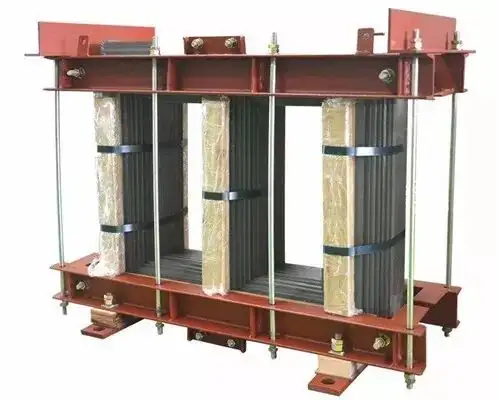
Problem 4: Interlaminar Insulation Failure (Short-Circuit in the Core)
What It Looks Like
When the insulating layer between silicon steel laminations breaks down locally, circulating currents flow through the short-circuited path, generating localized intense heat — sometimes called a “hot spot.” In oil-immersed units, DGA may reveal elevated levels of carbon monoxide, ethylene, or acetylene. In dry type units, localized discoloration or carbonization may be visible on inspection.
Root Causes
- Mechanical damage during installation or transport: Impact or vibration can chip or crack the thin inter-laminar coating.
- Thermal aging: Repeated thermal cycling over years of service degrades the insulating varnish between laminations.
- Moisture ingress: Moisture can degrade the inter-laminar coating and facilitate electrochemical attack, particularly in units that have been stored outdoors or operated in humid environments without adequate sealing.
- Manufacturing defects: Insufficient coating application or inadequate curing during production.
Detection
The Epstein Frame test and the ring core test are standard laboratory methods for evaluating core loss in lamination samples. For in-service units, the best indicator is DGA (for oil types) or thermal imaging surveys.
VIEW HIITIO HIGH-EFFICIENCY DISTRIBUTION TRANSFORMERS

Three-Phase Pad-Mounted Transformers

Single-Phase Pad-Mounted Transformers

Oil Immersed Transformer

Dry Type Transformer
Problem 5: Core Ground Faults
What It Looks Like
A transformer core is typically bonded to ground at a single point to prevent floating potential. If the core develops a second unintended ground connection — due to insulation breakdown, mechanical contact with the tank, or assembly error — a circulating current loop forms through the core-to-tank path. The resulting I²R heating can be severe enough to cause local insulation damage and oil carbonization.
Root Causes
- Degraded core-to-tank insulation
- Mechanical contact established during a seismic event, shipping damage, or tank deformation
- Debris accumulation creating a conductive path
- Assembly errors during manufacture or maintenance
Testing
Core insulation resistance is routinely measured during routine maintenance and after any overhaul. The standard test measures resistance between the core ground strap and the transformer tank, with acceptable values typically above 100 MΩ. Any significant drop from baseline readings warrants further investigation.
Problem 6: Core Loss Deterioration Over Time
Even without a specific fault event, no-load (iron) losses in a transformer core can creep upward over the equipment’s service life. This is partly due to the aging of silicon steel under cyclic magnetization and thermal stress — a phenomenon known as magnetic aging. For operators tracking energy efficiency metrics, unexplained increases in no-load consumption on older units may indicate a core that has aged beyond acceptable parameters.
High-efficiency core designs using low-loss oriented silicon steel or amorphous alloy materials offer lower initial losses and demonstrate better resistance to magnetic aging. When evaluating transformer procurement, specifying core loss values by efficiency tier — such as DOE 2016 or IEC Tier 1/2 — helps ensure long-term operational economy.
Choosing a Transformer with Core Quality in Mind
Not all transformer cores are equal. Key differentiators include:
- Core material: Cold-rolled grain-oriented (CRGO) silicon steel is the industry standard; amorphous alloy offers superior no-load loss performance, especially at partial load.
- Lamination quality and stacking factor: Tighter stacking factors reduce effective air gaps and improve overall magnetic performance.
- Core geometry: Step-lap cutting techniques minimize joint losses at the core corners.
- Clamping design: Robust clamping systems preserve lamination compression over decades of thermal cycling and vibration.
- Manufacturing controls: Core cutting, stacking, and clamping should be performed under controlled conditions with dimensional verification at each stage.
Ready to Source a High-Efficiency Distribution Transformer? Talk to HIITIO
Get Engineering-Grade Transformer Solutions — Built to Your Specifications
At HIITIO, we design and manufacture a complete range of distribution transformers — including oil-immersed, dry type, three-phase pad-mounted, single-phase pad-mounted, and pole-mounted models — engineered to ANSI/IEEE, UL, CSA, and IEC standards. Our transformer cores use precision-cut silicon steel or amorphous alloy laminations, with optimized core geometry to minimize no-load losses and reduce audible noise.
Whether you are designing a utility distribution network, a renewable energy interconnection, or a commercial campus, HIITIO delivers reliable power distribution solutions backed by 20+ years of electrical manufacturing expertise. Request a Custom Transformer Quote at www.hiitio.com — our engineering team responds within 24 hours.


